
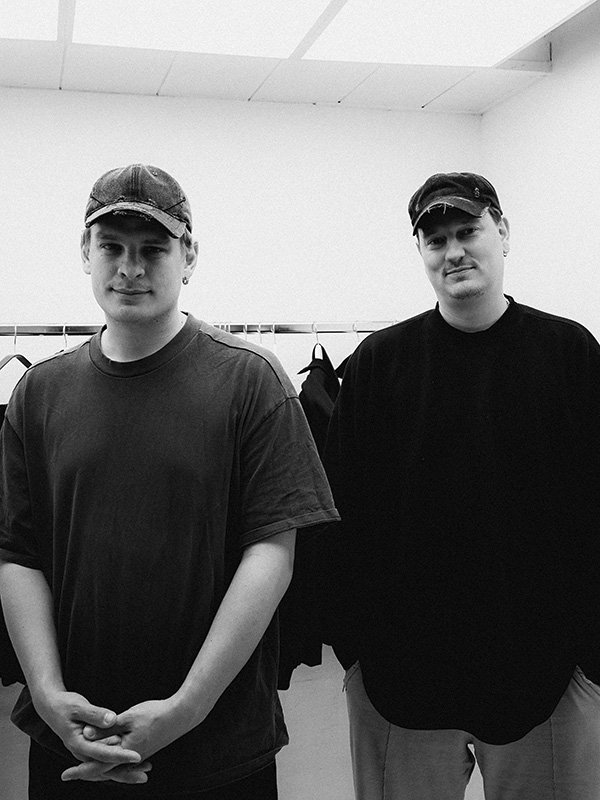
If Berlin were a fashion label, the metropolis would be the Haderlump collective, founded in 2021. Creative Director Johann Ehrhardt and CEO Julius Weißenborn know how to transfer the spirit of the city to fashion. With dark colors, daring shapes and the right amount of edginess, they attract more attention year after year, most recently with their „Ex Libris“ show at Berlin Fashion Week in the summer. During a visit to the studio in Berlin-Neukölln, the founders not only provide detailed insights into sketches and work processes, but also reveal why they have never really had much to do with fashion, why they produce exclusively with deadstock materials and what else Haderlump will become in the coming years.
Those who roamed the streets around the 18th century collecting scraps of fabric, wrapped in these old rags, were disdainfully referred to as Haderlump. Yet this frowned upon profession was a pioneer in recycling: the scraps of fabric were used to make paper. So the circular economy is not such a new idea after all. Anyone who still knows the term in the 21st century either has a niche interest in endangered expressions of the German language or is at home in the fashion industry – or both, like Haderlump CEO Julius Weißenborn, who read through piles of literature on the subject of tailoring and took a liking to the term Haderlump. He and Creative Director Johann Ehrhardt are the founders of the label, who ensure that surplus fabrics that would otherwise end up in the bin are turned into collections that set the pulses of edgy Berlin fashionistas and fashion editors alike racing. „We see ourselves more as a collective than as the two founders of Haderlump,“ Julius explains during a visit to the studio in Berlin-Neukölln.
Since the label was founded, the collective has grown steadily. A good ten people think, sew and style together. As a result, the young label has put on some pretty pompous fashion shows in recent years. For the „Aero“ show last summer, for example, they simply took over Berlin’s old Tempelhof Airport and had the models power-walking around historic airplanes. For the subsequent show „Solivagant“ at the S Bahnwerk Berlin-Schönenweide, the guests were transported across Berlin in S-Bahn trains and unloaded directly at the location. „We love telling stories and want our shows to be an immersive experience,“ says Julius. Thanks to such escapades, Haderlump has long since become a permanent fixture at Berlin Fashion Week, although they only held their first show in 2023 – mainly because a previous trip to Paris didn’t quite produce the desired result. „We had a showroom at Paris Fashion Week in 2022 and thought, either we sell 100,000 garments there now,“ says Julius. „Or we come back and show for the first time at Berlin Fashion Week,“ adds Johann. The sale of 100,000 pieces didn’t happen, but a few weeks remained to realize the very first fashion show. „It made sense to use our network and synergies here in Berlin,“ says Julius. And so they threw themselves head over heels into Berlin Fashion Week. With one eye twitching all the time and less than four hours of sleep a night, Johann created the first runway collection with just four people. „It was a bit unhealthy,“ he says looking back. But: „Actions like that weld the team together.“ According to Johann, all of the interns have subsequently applied to the label. „You can tell that they were involved in the design process right from the start and can identify with the collections,“ says the designer.
There is a good reason for the comparatively quieter „Ex Libris“ show at this year’s Berlin Fashion Week. On the one hand, the collective has grown and become more experienced. Instead of staying until four in the morning, Johann may now stay until midnight as the show approaches. And Julius explains: „We’ve attracted attention, now we want to focus on the clothes again. Because that’s really what it’s all about.“
FASHION DESIGNER, STORYTELLER
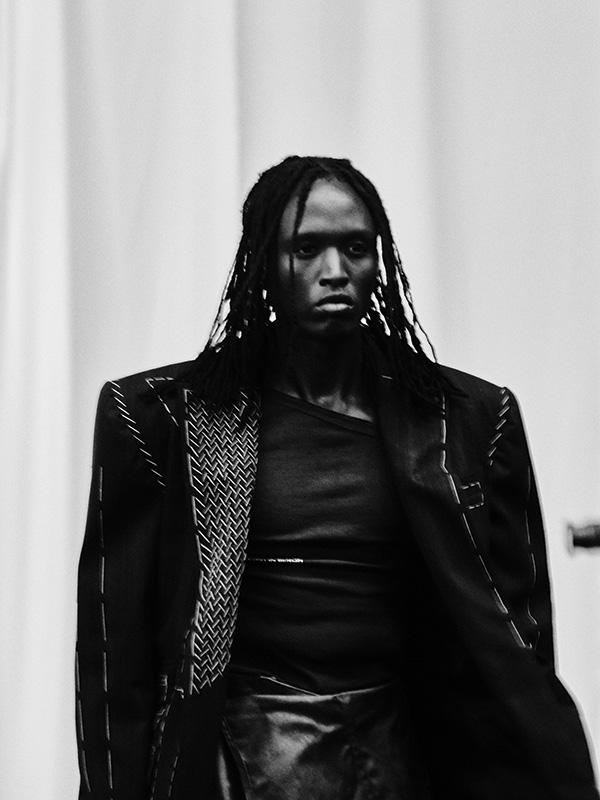
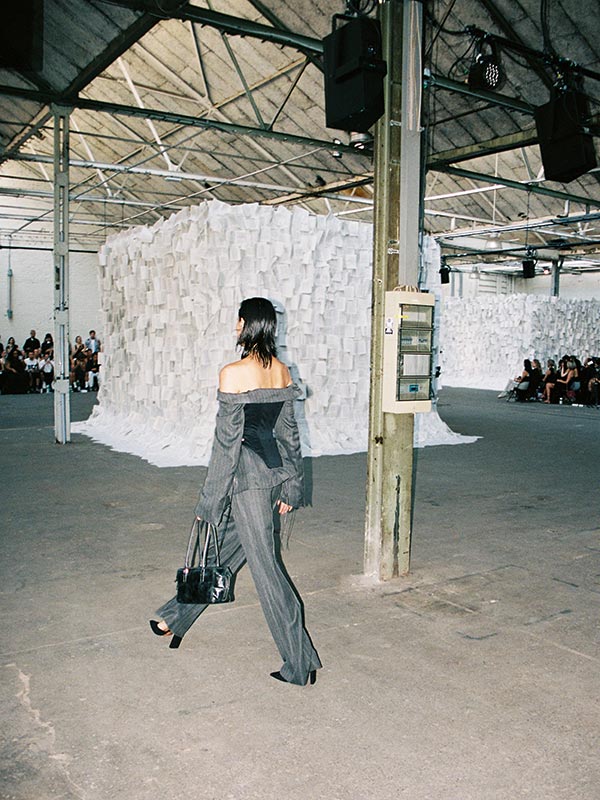
Berlin-Kreuzberg on a hot day in early July: the city’s fashionistas gather in the Haus der Visionäre artists‘ building. If you don’t know what’s happening on this Wednesday, you might think that Berghain has relocated at short notice. Because even a sweltering 35 degrees doesn’t stop real Haderlump fans from turning up dressed mostly in black and in several layers. Wherever you look, sophisticated, predominantly dark outfits with lacing, sunglasses, voluminous and asymmetrical cuts catch the eye. The audience translates the Haderlump aesthetic into their own style, creating a harmonious unity of fashion-conscious individualists. „We had around 700 guests at our first shows, but around 80 percent of them came from our local area,“ says Julius. The audience is no longer just friends and family. Press, influencers and industry professionals grab the seats in the front row to get a closer look at the new collection. The audience is as diverse as the models walking for Haderlump. For example, the iconic Berghain bouncer Sven Marquardt is also among the guests. Before the show, people are busy posing, filming and taking photos. The result? For days after the show, Instagram and co. were flooded with images and video footage of „Ex Libris“, not only from internet personalities, but also from numerous magazines and newspapers.
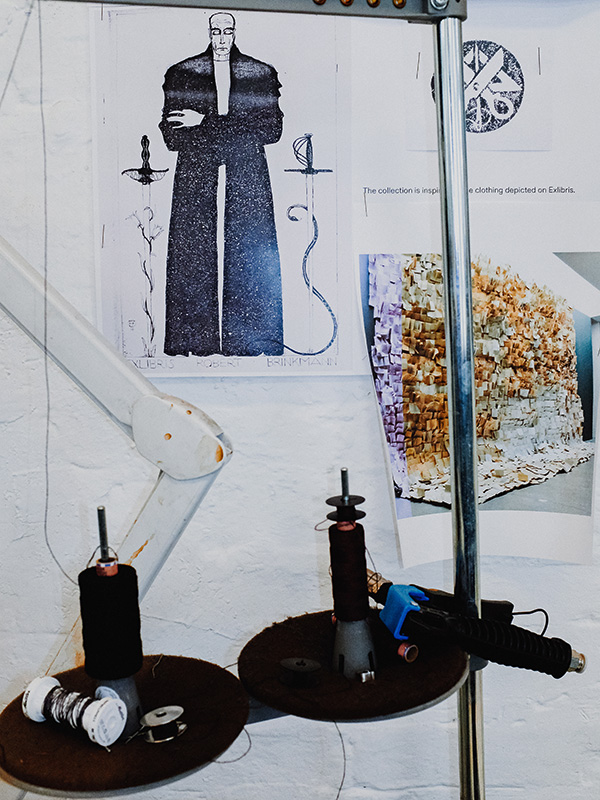
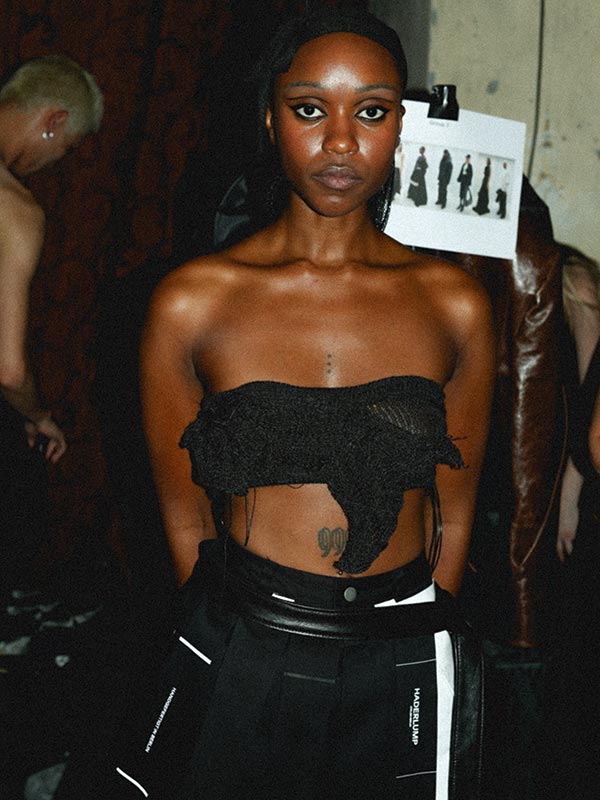
In the middle of the runway are two huge blocks covered in fluttering book pages. „I’ve been to over 10 libraries,“ says Johann, who thinks less of digital Pinterest mood boards and prefers to communicate his visions with his own sketches, photos and, in this case, library research. The idea for „Ex Libris“ came from an older couple Johann met in a bar. They told him about the old concept of Ex Libris, where people engraved their books with their very own stamp signature. Johann quickly translated this to the new collection and asked himself: „What does my own Ex Libris look like?“ After a lot of brainstorming and collecting of all kinds of coats of arms and religious symbols through to the depiction of professions, the oversized cloth in the entrance hall of the House of Visionaries shows an Ex Libris – in the Haderlump version. And it is this Spring Summer 2026 collection that really consolidates Haderlump’s core identity once again. Asymmetric cuts, ruffles, hoods and a minimalist color palette show the label as creative, innovative and deeply rooted in Berlin. You could spot influences from Margiela or Balenciaga, but that would be too easy. After all, Johann doesn’t necessarily find inspiration in other designers, but rather in stories, people and his home city of Berlin. „Johann simply walks through Berlin with his eyes wide open,“ summarizes Julius. This approach also resonates with the models. „We always hold open casting calls. This year, too, we had a few models who weren’t actually taking part in Fashion Week but wanted to be with us because they felt seen as people,“ says Johann, visibly proud. „We always try to create a look that makes the model say: ‚Ok, that’s me‘. We don’t want them to look dressed up, but dressed down,“ he adds. And that’s exactly what the mixed group of models looks like. Almost as if the most stylish people in Berlin had been plucked from the streets and sent onto the catwalk. „We simply try to stand for Berlin and are definitely inspired by the city,“ says Johann. „Berlin is creative, but also poor and has a lot of potential.“
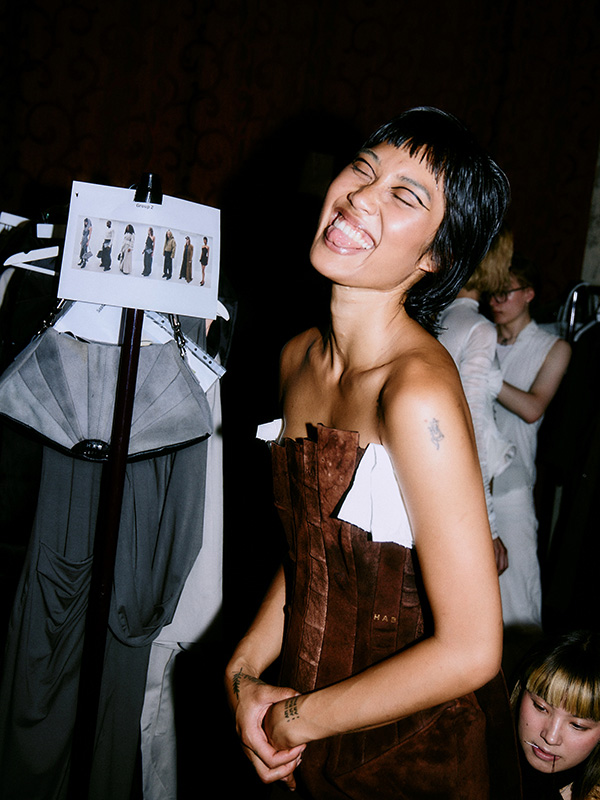
At the end of the show, it’s not just Johann and Julius who make a brief appearance, but the entire team, dressed in black, who do a lap to thunderous applause. „I do maybe ten percent of all the work,“ says Johann modestly. „I haven’t sewn a single piece myself for this collection,“ he adds. And yet the Creative Director’s artistic DNA is in the collection. During a visit to the studio, he takes us through the process step by step. The mood boards for the current collection are still hanging on the wall. „I always create the concept with ten drawings. After a round of feedback, I give the drawings to the team and let them create until 400 sketches are produced, from which we then select the best 30,“ he explains. The design process also continues during the production of the first prototypes. Anything we don’t like is kicked out or changed. „We then try out the designs on the body and at the very end, the stylist looks over them again and gives her interpretation,“ explains Johann. This process takes around three months, although the idea often comes earlier. „Johann usually has an idea for the next show just one day after the show,“ says Julius. The concepts for the next two shows are already running through the creative mind.
RADICALLY SUSTAINABLE
A good two weeks after Berlin Fashion Week, „Ex Libris“ is still reverberating. „We’ve never had as much press as this time,“ says Julius and is clearly delighted with this development. What does that do to a label that is still in its infancy? „I sometimes look at the clock and ask myself: ‚How have four years gone by?“ philosophizes Julius. „I would never have thought that Vogue Runway, for example, would be writing about us now,“ he adds. Being part of one of the most hyped Berlin labels was apparently not the plan of the two boys, who have known each other for ten years. Perhaps that is their secret. Julius immersed himself in the NGO world after studying economics and politics. Johann once worked for SOS Children’s Villages and Hollister before training in gastronomy. Years of toiling away in the hotel industry gave him two months off at the beginning of 2020, during which he started sewing. „It was actually just because I was in a party mood – and because I once attended a sewing course in eighth grade,“ he says. And Julius had always wanted him to sew his own clothes. The party quickly turned serious and Johann ended up going back to school until he had a degree in fashion design in his pocket. „I think it was quite good that we started the label as adults and not as 18-year-olds,“ he says. The pandemic doesn’t seem to have been the worst thing for the creative industry after all. Julius‘ NGO job was in limbo during the first lockdown. He read Toms Shoes founder Blake Mycoskie’s book „Start Something That Matters“ and seemed to look into a mirror image: „I thought to myself: I don’t know anything about fashion, but I want to make a difference. And I know this guy who sews T-shirts,“ says Julius. To this day, the book has a place of honor in the studio. „The whole thing actually started as a crazy idea,“ he says. One that works pretty well.
With an educational loan of 7,000 euros each, the two bought three sewing machines and started making T-shirts and hoodies in a warehouse in Lichtenberg. With a bunch of friends, the 220 square meter warehouse quickly filled up and the rent could be split. The two have not forgotten the early days in the unheated hall: A photo – placed next to Blake Mycoskie’s book – commemorates the birth of Haderlump. The pair’s extensive network led to T-shirts and hoodies suddenly being joined by custom orders for Hamburg R’n’B singer Zoe Wees thanks to a stylist friend. She hit the big time in 2022, appearing on Jimmy Kimmel and at the AMAs and wearing a total of 25 custom-made Haderlump products. To this day, the team still produces custom orders on request. In the beginning, a tree was planted for every piece sold. 800 trees owe their existence to the two Berliners. But they didn’t want to focus too much on this promise. „Sustainability is a must for us,“ says Julius, adding: „If you’re not sustainable today, what are you doing?“ However, experience and a number of studies show that design is still the deciding factor when making a purchase. „Nobody buys an ugly T-shirt just because it’s sustainable. So we want to make cool products that people want. Anyone who takes a closer look at us will quickly find out that we only work with sustainable fabrics and produce everything ourselves in the studio,“ says Julius.
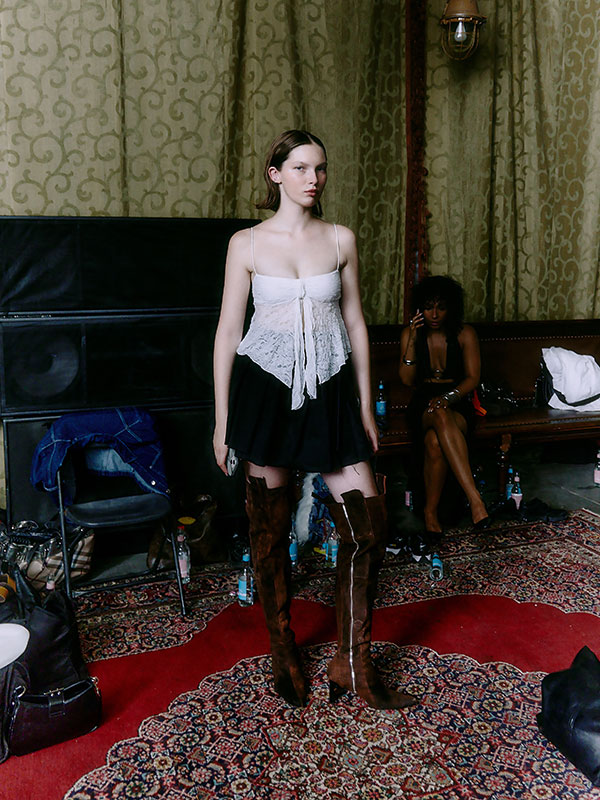
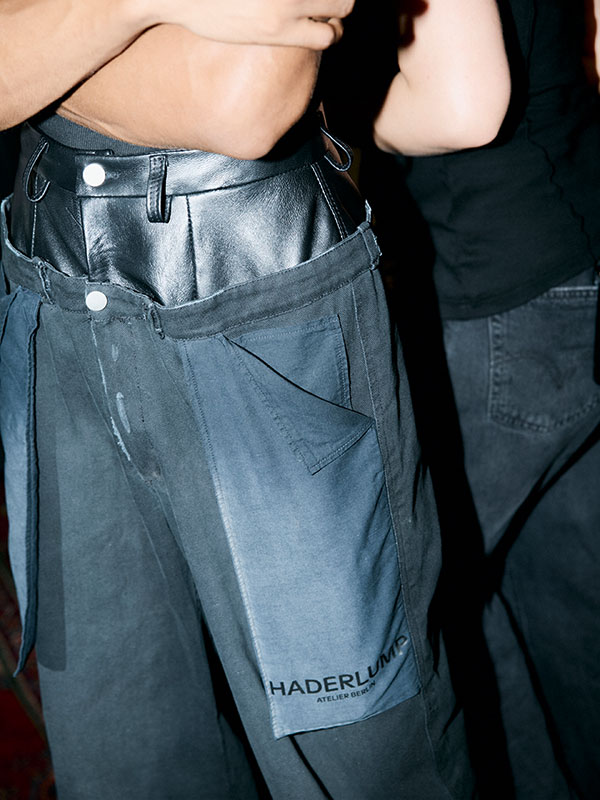
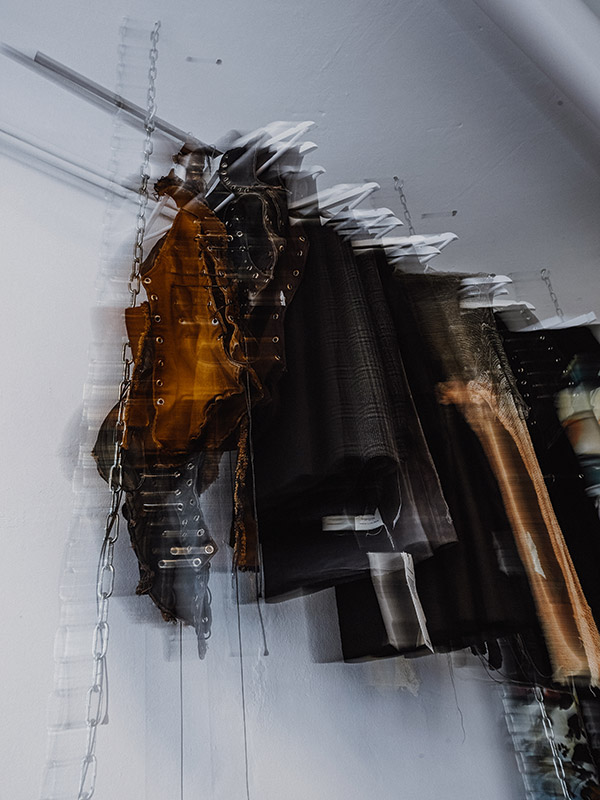
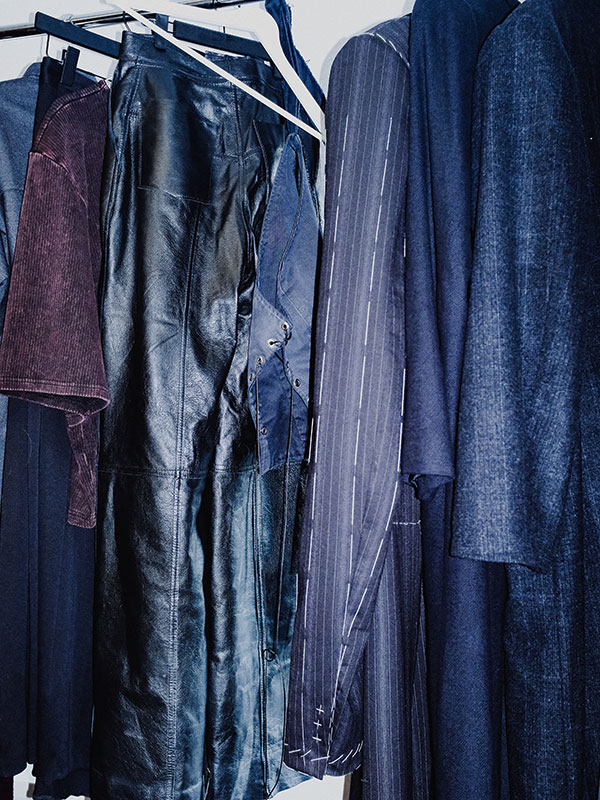
Like their namesakes, the Haderlumpen from centuries past, the Haderlump team also uses fabrics that already exist – so-called deadstock materials. And there are quite a few of these lying around, because when brands have fabrics produced, around ten percent surplus is always produced so that the planned number of garments can still be sewn in the event of material defects. „If big brands have a million meters produced, then ten percent of the surplus is 100,000 meters that were previously burned or simply lying around. And of these 100,000 meters, we now need a maximum of 1,000 meters, because we can make 500 to 700 products from this alone,“ calculates Julius, who really gets going on this topic. Working with deadstock materials for the ready-to-wear line has therefore developed quite organically and can continue to do so for a long time to come thanks to this gigantic surplus production. There is no loss of quality either, because the surplus fabrics are A goods – just far too much. For the show pieces, they also source leather and denim jackets from the Berlin textile port. All production still takes place on site in the Neukölln studio. But what will happen if the Haderlump hype doesn’t die down and growth continues as rapidly as before? „We’re currently in a crunch time as a young label,“ says Julius. „Sustainability is deeply embedded in our DNA and it will always stay that way. But as soon as we grow up as a label, i.e. we open up to retail, we will have to outsource some of our production“. According to Johann, the word sustainability is used far too often anyway. „For us, it means producing on demand and therefore never producing too much. And to continue working with deadstock materials in the future,“ he says. He also dreams of having his own factory, where orders would come in and then be produced on demand, while the studio would only be used for show pieces and custom orders. „Now it’s the professionals who are watching us, and we have to convince them now. Let’s see where the journey takes us,“ muses Julius. It doesn’t really matter where the label ends up, because one thing is certain: they will always have new stories to tell and captivate everyone who looks.
HADERLUMP STUDIO BERLIN
Some of us were thrown off course by the pandemic, others were steered onto the right path thanks to it. Creative Director Johann Erhardt started sewing in 2020. He launched Haderlump with his co-founder Julius Weißenborn. The Berlin label has been showing its collections at Berlin Fashion Week since 2023. And proves anew with every show that sustainability is not only feasible, but can also look extremely cool.
haderlump.berlin
Grab a piece from the current Haderlump collection.
Photos: Jérémie Luke Dubois, Olena Mindrina, Anastasia Potapova, Szymon Stepniak, Josefine Zürcher
Yannik Zamboni is also serious about sustainability. We met him for a chat last year.
